Dada
Dada was an artistic and literary movement that began in Zürich, Switzerland. It arose as a reaction to World War I and the nationalism that many thought had led to the war. Influenced by other avant-garde movements - Cubism, Futurism, Constructivism, and Expressionism - its output was wildly diverse, ranging from performance art to poetry, photography, sculpture, painting, and collage. The movement ended in 1924, becoming unstable, and moving closer towards Surrealism.
In 1916, various artists, including Sophie Taeuber, and Hugo Ball, the man who founded and lead the movement, went to the Cabaret Voltaire, discussed art and put on performances, showing how they were disgusted with World War 1 and the things that caused it.
Some say that Dada as we know it was formed from this on October 6th, but others say that it grew from an existing tradition of art from Eastern Europe.
Duchamp was the first artist to use a ready-made and his choice of a urinal was guaranteed to challenge and offend even his fellow artists. There is little manipulation of the urinal by the artist other than to turn it upside-down and to sign it with a fictitious name. Duchamp says that he did not create this piece, and he submitted it for a friend, who used the alias R.Mutt.
 |
| (Source) |
This work is a classic example of Dada irreverence towards traditional art. Duchamp transformed a cheap postcard of the Mona Lisa (1517) painting by drawing a moustache and a goatee onto Mona Lisa's face and labelled it L.H.O.O.Q. If the letters are pronounced as they would be by a native French speaker, it would sound as if one were saying "Elle a chaud au cul," which loosely translates as "She has a hot ass." Again, Duchamp managed to offend everyone while also posing questions that challenged artistic values, artistic creativity, and the overall canon.
 |
| (Source) |
Sophie Taeuber-Arp
Born in Davos, Switzerland in 1889 as Sophie Henriette Gertrude Taeuber, Taeuber-Arp is now recognised as one of the key figures in the Dada artistic movement, though in her lifetime she fought for her less figurative style of art to be recognised as fine art.
Taeuber-Arp studied drawing and attended the School for Applied and Free Art in Munich before leaving for Zurich in 1915, where she met and later married French sculptor, painter and collagist Hans Arp in 1922.
She is considered a founder member of the anarchic Dada movement, which celebrated the avant-garde, conceptual approach to creating art, often resulting in unorthodox materials appearing in abstract, unusual compositions.
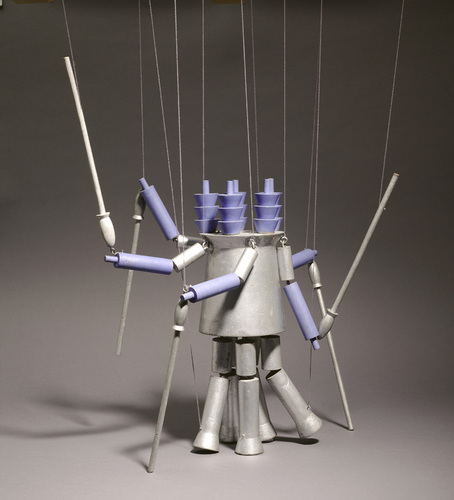
 |
| (Source) |
 |
| (Source) |



No comments:
Post a Comment